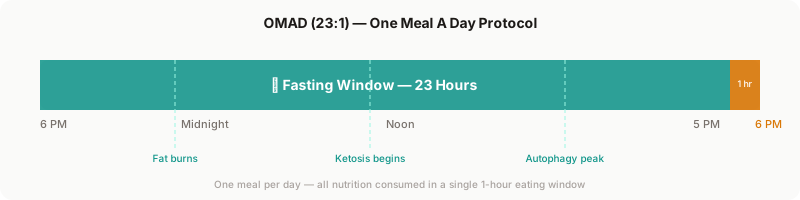
OMAD, One Meal A Day, is intermittent fasting taken to its most aggressive expression. You eat once per day, within roughly a 1-hour window, and fast for the remaining 23 hours. It's a 23:1 protocol, and it produces dramatic metabolic effects. It also requires significant lifestyle adjustment and isn't appropriate for everyone.
This guide covers the research on OMAD, who benefits, who shouldn't try it, and how to calculate your fasting window if you decide to start. Use our OMAD fasting calculator to find your exact fast-end time, select the OMAD (23:1) protocol and enter your meal time.
What OMAD Actually Is
OMAD means eating all your daily nutrition in one sitting, typically within a 1-hour window. The rest of the 24-hour period is a complete fast (water, black coffee, plain tea only). Unlike 16:8, where you have 8 hours to eat, OMAD requires you to consume everything you need in a single meal.
A practical example: you eat at 5 PM. Your fasting window runs from 6 PM to 5 PM the next day, 23 hours. Calculate your specific OMAD window by entering hour 17, minute 0 for a 5 PM meal with the OMAD protocol selected. The calculator confirms your next meal time and how many hours remain in your fast.
The Metabolic Case for OMAD
OMAD extends all the benefits of 16:8 and 18:6 significantly:
Deeper ketosis. After 20+ hours of fasting, blood ketone levels are meaningfully elevated for most people, even without a ketogenic diet. This sustained fat oxidation period is more pronounced than what 16:8 achieves.
Enhanced autophagy. The 23-hour fasting window provides substantially more time in the autophagy state than shorter protocols. Research by Yoshinori Ohsumi (2016 Nobel Prize in Physiology) established the mechanisms of autophagy, cellular cleanup of damaged proteins and organelles, which accelerates significantly after 16+ hours of fasting.
Dramatic insulin reduction. With only one insulin spike per day versus the typical 3–5 meals, insulin remains low for 23 hours. This extended low-insulin period maximizes fat access and may improve long-term insulin sensitivity more aggressively than 16:8.
Growth hormone. Fasting-induced growth hormone elevation is more pronounced at 20–24 hours than at 16 hours, based on studies from the Intermountain Medical Center. This supports muscle preservation during the fat-loss period.
The Research on OMAD
OMAD has fewer direct clinical trials than 16:8, but the data that exists is promising:
A 2022 study in the New England Journal of Medicine (Wilkinson et al.) compared OMAD to unrestricted eating in adults with metabolic syndrome over 14 weeks. The OMAD group lost significantly more body fat and showed greater improvements in insulin resistance and liver fat compared to the control group.
Varady et al. compared OMAD to 16:8 over 12 weeks and found OMAD produced greater weight loss (6.9 lbs vs. 4.4 lbs) but also higher rates of adverse effects including irritability, constipation, and nutrient deficiency in participants who didn't plan their one meal carefully.
The takeaway: OMAD produces stronger results than 16:8, but the risk of doing it poorly is higher.
Who OMAD Is (and Isn't) For
Good candidates for OMAD:
- People who've successfully practiced 16:8 or 18:6 for at least 4–8 weeks
- Individuals with significant weight loss goals (40+ lbs)
- People who find meal planning simpler with one meal to plan
- Those who naturally feel comfortable skipping multiple meals
Poor candidates for OMAD:
- Beginners to intermittent fasting (start with 16:8 first)
- Anyone with a history of disordered eating
- People on medications requiring food (especially metformin, blood pressure medications)
- Pregnant and breastfeeding women
- People with Type 1 or poorly controlled Type 2 diabetes
- Athletes with high training volumes (recovery suffers on one meal unless the meal is extremely well-planned)
If you're unsure whether OMAD is appropriate for your health situation, consult a physician or registered dietitian before starting. Our About page explains how we approach the science and limitations of fasting protocols.
Nutrition on OMAD: The Critical Challenge
The biggest risk of OMAD isn't the fasting, it's the meal. One meal must deliver everything your body needs in 24 hours:
- Protein: 0.7–1g per pound of body weight. For a 165-lb person, that's 115–165g of protein in one sitting, difficult but achievable. Focus on high-protein foods: chicken breast, eggs, beef, fish, Greek yogurt, cottage cheese.
- Fiber: 25–35g. Leafy greens, legumes, and cruciferous vegetables should take up significant plate space.
- Micronutrients: A multivitamin helps, but whole food sources are more reliable. Liver, oysters, and leafy greens cover most micronutrient gaps.
- Calories: Don't restrict calories severely on OMAD. Most people doing OMAD naturally eat 1,200–1,800 calories in one sitting, this is fine for fat loss. Going below 1,000 calories per day causes muscle loss and nutrient deficiency.
A sample OMAD meal for a 165-lb person: 8 oz grilled salmon, 2 cups roasted vegetables, 1 large sweet potato, 1 cup Greek yogurt with berries. That's roughly 900–1,100 calories, 85–95g protein, and solid micronutrient coverage. You'd add a second protein source (eggs or cottage cheese) to hit 130g+.
Calculating Your OMAD Window
Use our fasting calculator with the OMAD protocol selected. Enter the hour and minute of your meal time. The calculator shows your next fast-end time, when you can eat again tomorrow.
Example: you eat at 6:00 PM today (hour 18, minute 0). Select OMAD (23:1). Your fast-end time is 5:00 PM tomorrow. The eating window runs 5 PM to 6 PM. Your fast-end time and next eating window are visible at a glance.
OMAD vs. 16:8: Which Gets Better Results?
For weight loss: OMAD produces faster fat loss in most studies. For sustainability: 16:8 is dramatically easier to maintain long-term and fits normal social life. For metabolic health improvement: both produce meaningful changes, with OMAD showing stronger insulin sensitivity improvements.
The typical recommendation: start with 16:8, transition to 18:6 after 4–8 weeks, and consider OMAD only if you've demonstrated you can sustain shorter fasting protocols. OMAD is most effective as a tool used deliberately, perhaps 3–4 days per week, rather than a permanent lifestyle for most people.
Compare the two protocols in detail in our 18:6 vs 16:8 guide.
OMAD and Social Life: The Real Constraint
The hardest part of OMAD isn't hunger. It's social. Most work environments involve lunch. Most family routines involve breakfast. Most celebrations involve food at variable times. A 1-hour eating window means that if your window is 6–7 PM and a friend's birthday dinner starts at 7:30 PM, you have a problem.
People who sustain OMAD long-term typically do one of two things: they choose an eating window flexible enough to accommodate social meals (keeping the window end time open to 8 or 9 PM), or they use OMAD as a temporary protocol rather than a permanent lifestyle. Three OMAD days per week with 16:8 on the remaining days produces meaningful metabolic benefits while preserving enough flexibility for a normal social life.
What Happens If You Miss Your OMAD Window?
If you miss your OMAD eating window entirely (e.g., you were traveling, got sick, or the meal just didn't happen), the safest response is to eat normally the next day rather than extend the fast further. A 48-hour fast after an unplanned 23-hour fast creates a significant energy deficit that can cause muscle loss and electrolyte imbalance.
If you ate later than planned (meal at 9 PM instead of 6 PM), simply start the next day's window at the same time relative to that meal. The 23:1 protocol is measured from the last bite of your meal, not from a fixed clock time. Use the fasting calculator to recalculate your window after any schedule disruption.