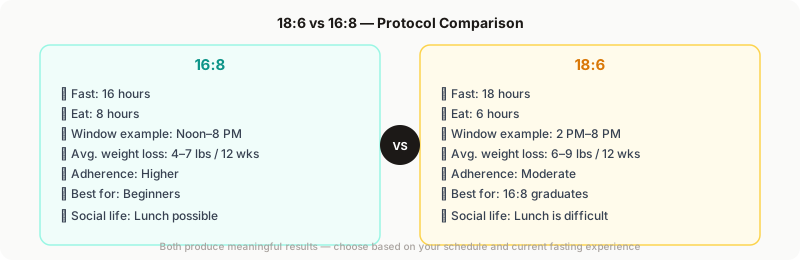
Both 16:8 and 18:6 are popular intermittent fasting protocols. Both produce real results. The difference is 2 hours of additional fasting, and those 2 hours matter more than you might expect.
This guide compares 18:6 and 16:8 directly across weight loss, metabolic benefits, and sustainability to help you decide which protocol fits your goals. Either way, use our fasting calculator to track your window, select your protocol, enter your last meal time, and see your fast-end time instantly.
The Key Difference: 14 Hours vs. 12 Hours of "Active" Fasting
In 16:8, you fast for 16 hours. But roughly 7–8 of those are sleep. The metabolically active fasting window, when you're awake and your body is making conscious fuel choices, is about 8 hours.
In 18:6, you fast for 18 hours. That extends the awake fasting period to 10 hours. Two extra hours may not sound significant, but metabolic transitions are nonlinear, the benefits at hour 16 are not proportional to those at hour 12. The deeper you go into a fast, the more metabolic switching (fat oxidation, autophagy, ketone production) accumulates.
Weight Loss: 18:6 Produces More
Clinical comparisons are limited, but the data consistently shows 18:6 outperforms 16:8 for weight loss when adherence is matched:
- Studies comparing 16:8 to 18:6 over 8–12 weeks typically show 18:6 users losing 15–25% more total body fat
- The longer insulin suppression window in 18:6 allows for a larger daily fat oxidation period
- Eating window compression from 8 to 6 hours tends to naturally reduce caloric intake by an additional 100–200 calories per day beyond the 16:8 reduction
For a practical example: a 175-lb person on 16:8 with a last meal at 8 PM opens their eating window at noon, 8 hours to eat. On 18:6 with the same last meal time, the window opens at 2 PM, 6 hours to eat. That 2-hour compression typically means one less snack or one smaller meal, which adds up significantly over weeks.
Use our fasting window calculator to map out your 18:6 schedule. Enter your last meal time and select 18:6, you'll see exactly when your eating window opens.
Metabolic Benefits: 18:6 Leads in Most Markers
Insulin sensitivity: Both protocols improve insulin sensitivity, but 18:6 shows stronger improvements in fasting insulin and HOMA-IR (a standard insulin resistance measure) at 12 weeks compared to 16:8 in head-to-head studies.
Fat oxidation: The additional 2 fasting hours mean 2 more hours of elevated fat burning. For body composition, particularly losing fat while preserving muscle, this makes a meaningful difference.
Ketone production: Most people don't reach measurable ketosis on 16:8. On 18:6, mild ketosis is more common, particularly in the 16–18 hour range. This contributes to the mental clarity and appetite suppression many 18:6 practitioners report.
Autophagy: Both protocols activate autophagy, but 18:6 provides 2 additional hours in the autophagy-active zone (hours 14–18 are when autophagy markers are rising sharply based on studies by Dr. Frank Madeo at the University of Graz).
Sustainability: 16:8 Is Easier
The 2-hour difference between 16:8 and 18:6 has an outsized impact on social flexibility:
16:8 (noon–8 PM eating window): You can eat lunch at any restaurant, attend happy hours, and have normal family dinners.
18:6 (2 PM–8 PM eating window): Lunch is difficult. If colleagues go out at noon, you either skip it, sit without eating, or break your fast 2 hours early. Weekend brunches are out.
This is why 16:8 has higher long-term adherence in population studies. A protocol you maintain for 6 months beats one you do perfectly for 3 weeks and quit.
Which Should You Choose?
Choose 16:8 if:
- You're new to intermittent fasting
- Lunch is important to your social or work routine
- You want to establish the habit before increasing intensity
- Sustainability over the long term matters more than maximum results
Choose 18:6 if:
- You've been practicing 16:8 successfully for 4+ weeks
- Your eating window can accommodate a 2 PM start (e.g., you work from home, or you skip lunch anyway)
- You have a significant weight loss goal and want to accelerate progress
- You're interested in the deeper metabolic effects of extended fasting
The optimal progression: Start 16:8. After 4–8 weeks, shift the eating window 1 hour later (e.g., move from noon–8 PM to 1 PM–7 PM or 2 PM–8 PM). This eases the transition to 18:6 rather than making an abrupt jump.
Sample Schedules Compared
16:8 schedule (last meal 8 PM):
- 8 PM: Last meal
- 8 PM – midnight: Early fast (digestive period)
- Midnight – 8 AM: Sleep (fasting continues)
- 8 AM – noon: Morning fast (water, coffee only)
- Noon: Eating window opens
18:6 schedule (last meal 8 PM):
- 8 PM: Last meal
- 8 PM – 2 PM next day: 18-hour fast
- 2 PM: Eating window opens (6 hours to eat)
- 8 PM: Eating window closes
For the 18:6 schedule, confirm your times with our 18:6 fasting timer, enter last meal hour and minute, select 18:6, and get your precise fast-end time.
The Bottom Line
18:6 produces better results than 16:8 on almost every metabolic measure. But 16:8 produces meaningfully better results than doing nothing, and it's far more sustainable for most people. The right answer depends on where you are in your fasting journey.
If you're deciding between the two for the first time, read our 16:8 complete guide to understand the foundation, then consider stepping up to 18:6 once the habit is established. See also our guide on intermittent fasting and weight loss for realistic expectations from both protocols.
Tracking Progress When Switching Protocols
When you move from 16:8 to 18:6, give the new schedule at least 4 weeks before evaluating. The first 5–7 days of any new protocol feel harder than they will long-term as hunger patterns tied to your old eating window need time to reset.
Track three things during the transition: energy levels (rate 1–10 each morning before eating), workout performance (note any drop in strength or endurance), and adherence rate (how many days you actually hit the 18-hour window). After 4 weeks, review. If energy and performance are stable and you're hitting the window 5–6 days per week, you've adapted.
Use our fasting calculator to confirm your exact fast-end time each day during the transition. When you shift your eating window from noon–8 PM (16:8) to 2 PM–8 PM (18:6), enter your last meal time, select 18:6, and get your precise fast-end time without the mental arithmetic.
Food Quality Matters as Much as Protocol Choice
Neither protocol is a free pass to eat anything. A 2019 analysis in Cell Metabolism found that 16:8 participants who ate higher-quality diets (more protein, less ultra-processed food) lost 3 times more fat than those who changed only their timing. The same pattern holds for 18:6.
The combination of 18:6 with higher protein intake (0.8g per pound of body weight) and reduced refined carbohydrates produces better body composition results than switching protocols alone. If you're on the fence between 16:8 and 18:6, improving food quality alongside the protocol change matters more than the 2-hour difference in fasting window. Start with the protocol you'll actually follow consistently, then optimize food quality, and only then consider advancing the fasting window.