Intermittent fasting works for weight loss. Multiple randomized controlled trials confirm it. The real question is why it works and whether it outperforms other approaches, and the answer is more nuanced than the headlines suggest.
This guide cuts through the noise and covers what the best studies actually show, why IF produces weight loss (and what limits it), and how to use our fasting calculator to stay on a schedule that gets results.
The Research Summary: What We Actually Know
A 2020 meta-analysis in Obesity Reviews analyzed 27 randomized controlled trials on intermittent fasting protocols and found average weight loss of 0.8–13% of body weight over 4–24 weeks. That's a wide range because it includes everything from 5:2 to OMAD to 16:8.
The more targeted research on 16:8 specifically: a 2020 Cell Metabolism trial (Lowe et al., 116 participants, 12 weeks) found that the 16:8 group lost an average of 4.4 lbs more than the control group without any dietary instruction. They ate whatever they wanted, the only change was timing.
Dr. Krista Varady at the University of Illinois, one of the most prolific IF researchers, has published studies showing 16:8 produces 3–8% body weight loss over 12 weeks in people with obesity, with improvements in blood pressure, fasting glucose, and LDL cholesterol.
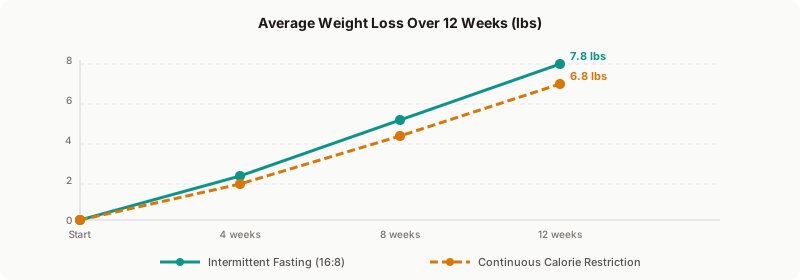
The honest comparison: Head-to-head trials comparing IF to continuous calorie restriction (CCR) show roughly equal weight loss at 12–24 weeks. IF is not a metabolic miracle that burns fat faster than other methods. Its primary advantage is adherence, most people find it easier to not eat until noon than to count every calorie all day.
Why Intermittent Fasting Produces Weight Loss
1. Reduced Caloric Intake (The Main Driver)
When you compress your eating into 8 hours instead of 16, most people naturally eat fewer calories, not because they're trying to restrict, but because there's simply less time and opportunity to eat. Studies consistently show IF participants consume 200–500 fewer calories per day than non-fasting controls, even without dietary guidance.
A 165-pound person on a 16:8 fast burns roughly 1,210 kcal during the fasting period (you can calculate this with our calorie burn estimator by entering your weight). That's not all fat, your body burns a mix of glycogen and fat during fasting, but it illustrates the energy flux involved.
2. Hormonal Changes
Beyond calories, IF produces hormonal shifts that favor fat loss:
Insulin reduction: Lower insulin during fasting unlocks fat stores. Adipose tissue releases fatty acids for fuel only when insulin is low. Consistently elevated insulin (from all-day eating) keeps fat locked in storage.
Growth hormone elevation: Extended fasting (especially 16+ hours) triggers a 5-fold increase in growth hormone, according to research at the Intermountain Medical Center. Growth hormone preserves lean muscle mass during weight loss, a significant advantage over simple calorie restriction.
Norepinephrine increase: Short-term fasting increases norepinephrine, which increases resting metabolic rate by 3–14%. This partly explains why many IF practitioners report more energy during the fasting period rather than less.
3. Fat Oxidation Preference
After 12–16 hours of fasting, fat oxidation (fat burning) becomes the body's dominant fuel pathway. Studies using respiratory quotient measurements confirm the shift from carbohydrate to fat burning in the 14–18 hour fasting window. This is why people doing 16:8 consistently report different patterns of fat loss compared to pure calorie restriction, specifically, more subcutaneous fat loss relative to lean mass.
What Limits Weight Loss with IF
Compensatory eating. Some people unconsciously eat more during their eating window to make up for the fasting period. If you eat 800 extra calories between noon and 8 PM because you were "so hungry from fasting," you've erased the deficit. The research shows this is less common than expected, hunger hormones (ghrelin) actually adapt to the fasting schedule within 1–2 weeks, but it does happen.
Poor food quality. Eating within an 8-hour window doesn't mean a "free pass." If your eating window is filled with highly processed, calorie-dense foods, you can easily maintain or exceed your TDEE. IF without food quality attention produces slower results.
No caloric deficit. If you eat exactly as many calories in 8 hours as you previously ate in 16, weight loss stalls. IF creates the conditions for a deficit, it doesn't guarantee one.
Realistic Expectations
In clinical studies:
- 4 weeks: 1–3 lbs average loss (mostly water and glycogen initially)
- 8 weeks: 3–6 lbs average loss
- 12 weeks: 4–10 lbs average loss (highly variable based on adherence and food choices)
- 24 weeks: 8–15 lbs average in adherent participants
These numbers are for 16:8 without dietary restriction. If you combine IF with a moderate calorie reduction and high protein intake, results are substantially better.
The Weight Loss Sweet Spot
The most effective IF approach for weight loss:
- 16:8 protocol (accessible, sustainable, well-studied)
- Eating window of 10 AM–6 PM or noon–8 PM (aligns with circadian insulin sensitivity)
- Protein at every meal (0.7–1g per pound of body weight, preserves muscle during fat loss)
- No calorie tracking required, but be aware of portion sizes
- Consistent timing, fasting at the same hours each day maximizes hormonal alignment
Track your window with the fasting window calculator. Enter your last meal time and 16:8 protocol, you'll see exactly when your window opens tomorrow.
IF vs. Other Diets for Weight Loss
Compared to keto: IF produces similar or slightly less total weight loss but is substantially easier for most people to maintain long-term. Keto requires ongoing carbohydrate restriction; IF just requires timing.
Compared to low-fat diets: IF generally outperforms low-fat diets in metabolic markers (insulin, triglycerides, HDL) even at equivalent weight loss.
Compared to no intervention: IF is consistently effective across almost all clinical trials, with average weight loss of 4–8% of body weight over 12 weeks.
How Long Before You See Results?
Most people see scale weight drop in the first 1–2 weeks. This is largely water weight as glycogen stores decrease. True fat loss becomes measurable around weeks 3–5, when hormonal changes (lower fasting insulin, elevated norepinephrine) are consistent enough to accelerate fat oxidation.
At 8 weeks, most adults following 16:8 consistently lose 4–8 pounds of actual fat, with better results in people who had higher baseline insulin levels. At 12 weeks, those who maintained the protocol see results comparable to or better than continuous calorie restriction, with a significantly higher rate of adherence.
The most common reason people don't see results at the 4-week mark is inconsistent timing. A fasting schedule that varies by 3–4 hours day to day doesn't produce the circadian alignment benefits that amplify fat loss. Use the fasting window calculator to track your eating window daily, not just when you remember.
How to Maximize Fat Loss with IF
Read our guide on common intermittent fasting mistakes to avoid the patterns that most frequently stall progress. For beginners, our beginner's guide to intermittent fasting covers exactly how to start.
The bottom line: intermittent fasting works for weight loss reliably and sustainably for most adults. It's not magic, it works because it helps you eat less without tracking every calorie. Combined with quality food choices and adequate protein, 16:8 is one of the most practical and research-supported weight management strategies available.