Intermittent fasting works. The research is clear on that. But a significant portion of people who start IF don't see the results they expected, and in most cases, they're making one or more avoidable mistakes.
These aren't obscure problems. They show up repeatedly in IF communities and clinical studies as the primary reasons people plateau, quit, or feel terrible on a protocol that should work. Use our fasting calculator to keep your timing accurate, many of these mistakes trace back to inconsistent scheduling.
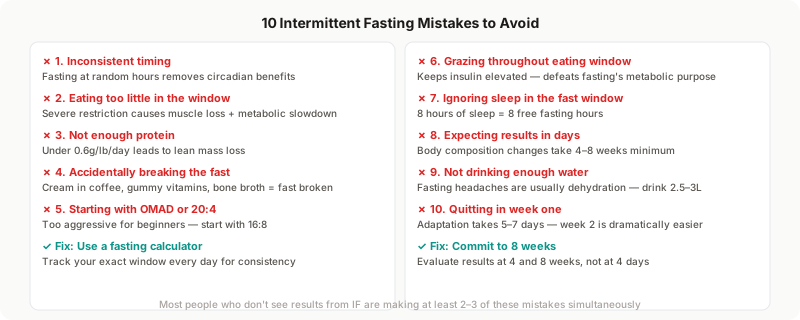
Mistake 1: Inconsistent Timing
This is the most common mistake and the one that undermines results the fastest. Fasting at different times each day, eating at noon on Monday, 3 PM on Tuesday, 10 AM on Wednesday, disrupts the circadian alignment that makes IF more effective than simple calorie reduction.
Dr. Satchin Panda's time-restricted feeding research at the Salk Institute specifically showed that circadian alignment (consistent meal timing aligned with daylight hours) amplifies metabolic benefits. Random timing removes this advantage.
Fix: Pick an eating window and maintain it within a 1-hour range. If your window is noon–8 PM, eating between 11:30 AM and 1 PM is fine. Eating at 8 AM is not. Use the fasting window calculator daily, enter last night's meal time and check your opening time.
Mistake 2: Eating Too Little During the Eating Window
IF isn't starvation. Combining a 16-hour fast with a 600-calorie eating window creates a severe deficit that triggers muscle loss, hormonal disruption, and metabolic adaptation (the body lowering its resting metabolic rate to compensate). This is especially problematic for women.
You should eat at or near your TDEE during the eating window. The fast creates the deficit by reducing eating opportunities, you shouldn't also cut calories aggressively within the window.
Fix: Estimate your TDEE (total daily energy expenditure) and aim to consume 80–90% of it during your eating window. For most adults, that's 1,400–2,400 calories depending on size and activity.
Mistake 3: Not Getting Enough Protein
Protein is the most important macronutrient for preserving muscle mass during fat loss. On IF, where you're already creating a deficit, inadequate protein accelerates muscle breakdown alongside fat loss. Studies show that IF participants with protein intake below 0.6g/lb of body weight lose significantly more lean mass than those at 0.8g+ per pound.
Fix: Target 0.7–1g of protein per pound of body weight per day, spread across 2–3 meals within your eating window.
Mistake 4: Accidentally Breaking the Fast
A common scenario: someone adds cream to their morning coffee without thinking, or takes a sugary vitamin gummy, or has a handful of almonds before their window opens. Any calories end the fast.
The most frequent culprits: creamer, milk, fruit juice, gummy vitamins, bone broth, flavored electrolyte drinks with sugar, and protein shakes. Our full list of what breaks a fast covers 15 common items with clear explanations.
Fix: Stick to water, black coffee, and plain tea during the fast. Check labels on any supplements you take in the morning.
Mistake 5: Starting with an Aggressive Protocol
Starting intermittent fasting with OMAD or 20:4 as your first attempt is like learning to run with a marathon. The metabolic and psychological adaptation required is significant, and most people quit within the first week due to hunger, irritability, and difficulty concentrating.
Fix: Start with 16:8. It's the most studied, most sustainable, and sufficient for meaningful metabolic benefits. Progress to 18:6 after 4–8 weeks if you want to increase intensity.
Mistake 6: Constant Snacking in the Eating Window
Having an 8-hour eating window doesn't mean 8 hours of continuous grazing. Eating every 90 minutes in the eating window keeps insulin elevated throughout, reducing the metabolic benefits of the previous fast. The insulin "valleys" between meals are part of what makes IF work.
Fix: Eat 2–3 proper meals with 3–4 hour gaps between them. Treat the eating window as structured meal time, not an all-day buffet.
Mistake 7: Ignoring Sleep in the Fasting Window
Sleep is the easiest fasting time, you're unconscious and not hungry. But many people don't account for it when designing their protocol. If you go to bed at 10 PM and wake up at 6 AM, you've already fasted 8 hours. For 16:8 with a noon eating window, you only need to hold off 4 more hours after waking. That's very manageable.
People who don't think about this often choose unnecessarily early eating windows (8 AM–4 PM) that conflict with work and social schedules, making the protocol harder than it needs to be.
Fix: Design your eating window around your natural sleep and social schedule. Most people do best with noon–8 PM or 1 PM–9 PM for 16:8.
Mistake 8: Expecting Results in Days
Intermittent fasting produces noticeable metabolic changes quickly, but visible body composition results take 4–8 weeks minimum. The first week often shows scale weight loss (mostly water and glycogen), followed by a plateau as the body adjusts. True fat loss accelerates in weeks 3–6 as the hormonal environment adapts.
Fix: Commit to 8 weeks before evaluating results. Take measurements and progress photos at 4 weeks and 8 weeks, scale weight alone is a poor indicator of IF success.
Mistake 9: Not Hydrating Enough
Fasting is mildly dehydrating. Glycogen depletion releases water (glycogen is stored with water), and the reduced caloric intake means less water from food. Many fasting "side effects", headaches, difficulty concentrating, fatigue, are dehydration, not true fasting effects.
Fix: Drink at least 2.5–3 liters of water during a 16-hour fast. Add sodium to your water (a pinch of sea salt) during longer fasts, especially if you exercise.
Mistake 10: Quitting After the First Hard Day
Hunger during the early days of fasting isn't a signal of failure. It's a learned response. Your stomach releases ghrelin (the hunger hormone) on schedule based on when you typically eat. Skip breakfast twice, and ghrelin starts adjusting by day three. By day five, most people notice morning hunger is dramatically weaker than it felt on day one.
Psychological adaptation lags behind physical adaptation. You may feel physically fine but still reach for food out of habit. Track hunger intensity on a 1–10 scale each morning for the first two weeks, you'll often see the numbers drop faster than expected.
Fix: Commit to at least 14 days before judging whether fasting works for you. If the 16-hour window feels impossible, start at 12:12, then step up to 14:10, then 16:8 over three weeks. A gradual ramp produces better compliance than white-knuckling through day one.
For a detailed starting guide, read our beginner's guide to intermittent fasting. For realistic expectations on results, see our breakdown of how intermittent fasting works for weight loss. Track your schedule consistently with our IF calculator, consistency in timing is the one factor that separates people who see results from those who don't.
One More Mistake: Not Tracking Your Window
Saying "I do 16:8" and eyeballing your eating window leads to drift. Most people who think they're consistently hitting 16 hours are actually averaging 13–14 when they check their actual meal times over a week. The difference matters. A real 16-hour fast produces measurably different insulin and metabolic outcomes than a 13-hour one.
Enter your last meal time into the fasting calculator each morning. It takes 10 seconds and eliminates the guesswork that causes most of the mistakes on this list.